
Searching sailboat transport near me usually means more than finding a truck with bunks. Sailboats travel differently from center consoles and express cruisers: the mast must come down and ride separately, the keel and draft dictate cradle or trailer support, and the yard’s step/unstep schedule has to line up with the highway appointment—not the other way around. This owner-facing guide explains those three differences so you can brief your marina and your carrier with the same facts.
Boat Transport Near Me is operated by Logi Transports LLC (Sebastian, FL · MC-1636889 · USDOT 4230991). Call (864) 791-5644 or email quotes@logitransports.com when you are ready to price a sailboat haul.
What makes sailboat hauls different
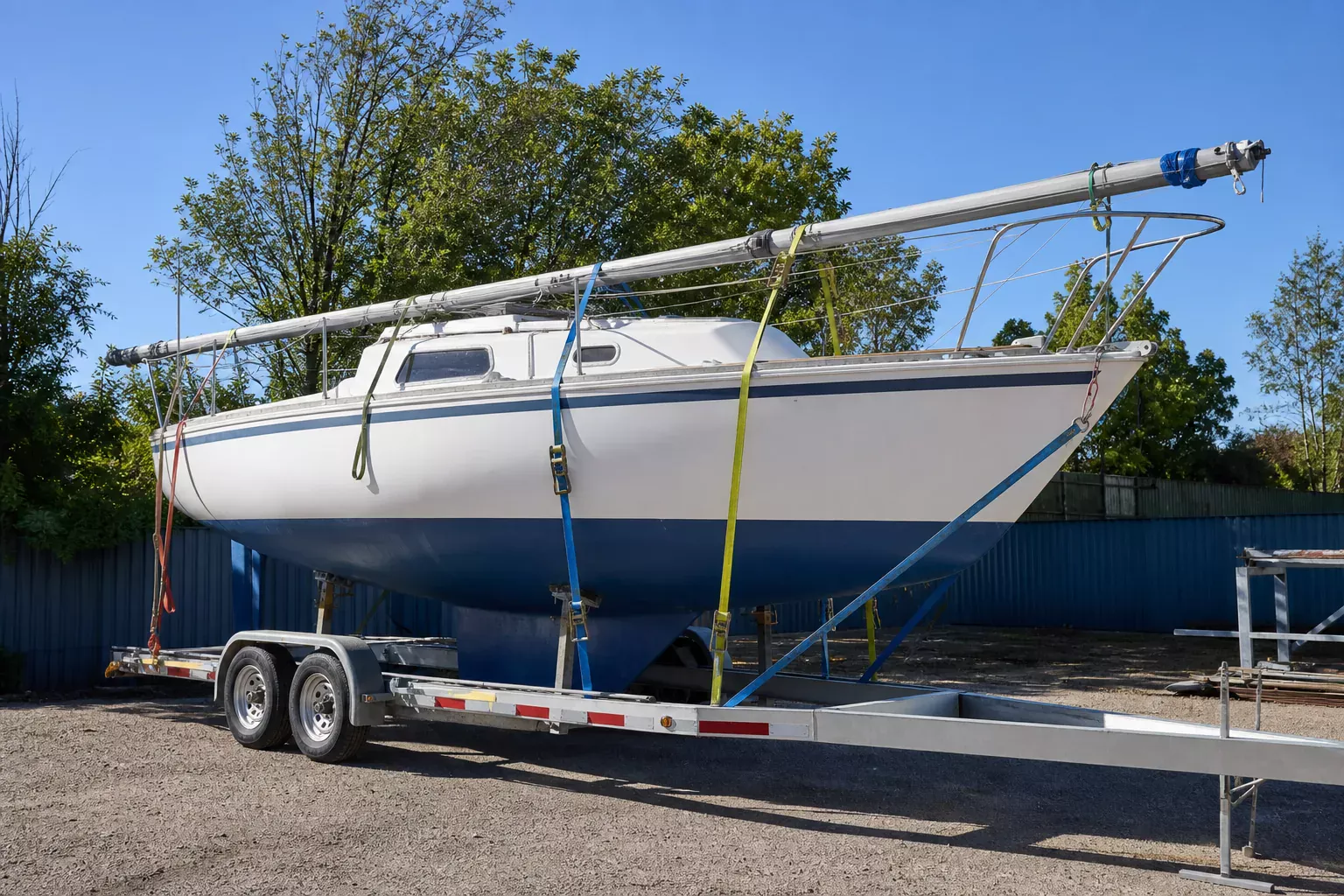
Powerboats mostly fight beam, hardtops, and radar arches. Sailboats add a vertical spar, standing/running rigging, and a keel that concentrates weight on a narrow footprint. Once the mast is stepped, overall height is almost never legal for interstate travel. Once it is unstepped, the hull still needs correct keel and pad support so gelcoat and structure are not point-loaded for hundreds of highway miles.
If you are still deciding whether your boat is a true yacht-haul candidate versus a trailerable package, read trailerable vs yacht boat transport first. For marina wet/dry loading choreography, use marina-to-marina boat transport. This guide stays on mast handling, keel support, and yard timing—the three items that most often delay a sailboat haul near me after the truck is already booked.
Vessel-type context for sail programs lives on our sailboats page; compare with powerboats and center consoles and yachts when mixed fleets or sisterships are moving in the same season.
Mast unstepping and packaging for the road
Mast unstepping boat transport is almost always a yard job, not a driveway DIY. A crane or travelift pulls the spar; the crew labels standing and running rigging, removes or bags fragile hardware (wind instruments, lights, antennas, winches that travel poorly), and lays the mast in a dedicated rack on the transport trailer—not lashed across the deck where it can chafe pulpits and coachroof.
Owner checklist that actually moves the needle:
- Book the unstep slot before the truck day. Same-morning “we’ll pull it when the driver arrives” is how you pay for idle tractor time.
- Ask who owns packaging. Many yards wrap the spar; some expect the owner to supply foam/carpet at contact points. Chafing at tie-downs is common on painted masts—plan for it rather than arguing about it after delivery.
- Do not insist the mast ride on the boat. Purpose-built boat transporters carry the spar on the trailer frame so height and securement stay controllable.
- Inventory spreaders, pins, and electronics in a labeled bag below. Reassembly speed at destination depends on how clean that inventory is.
Height is the highway reason the mast comes down. There is no single federal maximum height for recreational loads; states set vertical clearance and oversize permitting rules. In practice, many states treat roughly 13 feet 6 inches of total loaded height (pavement to highest fixed point) as the threshold where permits, approved routes, and sometimes height-pole escorts begin. Measure after the boat is on the trailer—including keel blocks, cradle rails, pulpits, and any gear left on deck—not from a brochure LOA drawing.
Federal rules do speak to boat-transporter length. Under 23 CFR § 658.13, boat transporters are specialized equipment: states may not set overall length limits below 65 feet for traditional boat transporters (or truck-trailer boat transporters) or 75 feet for stinger-steered combinations, exclusive of front and rear overhang, with minimum overhang allowances of 3 feet front and 4 feet rear. Florida’s highway statutes echo those specialized boat-transporter length concepts for in-state operation (Florida Statutes § 316.515). Length policy is not a mast rule—but it explains why professional sailboat carriers use purpose-built combinations instead of a generic flatbed.
Keel types, draft, and cradle vs trailer support
Sailboat keel transport is about how the boat’s weight leaves the water and sits for the trip. Fin keels, bulbs, wings, twin keels, and full/long keels each present different bearing areas. A deep fin with a bulb concentrates load; a shallow wing may need wider pad geometry; a full keel can look “stable” while still needing continuous blocking so the hull is not hung on a few hard points.
Two common support patterns:
| Support style | How it works | Watch-outs for owners |
|---|---|---|
| Purpose-built transport trailer / keel pad | Travelift sets the boat onto the carrier’s adjustable keel pad and side supports; driver builds the cradle around the hull while it is still supported by the lift. | Share accurate draft, keel type, and hull photos early. Racing or lightly built boats can show pad indentations—often treated as inherent to shipping, not “damage.” |
| Owner or yard cradle on the trailer | Boat already sits in a shipping cradle; trailer carries cradle + boat. | Extra cradle height can push the load over height. Carriers may reject unknown cradles or still add jack/pad support. Confirm acceptance before haul-out day. |
Deep-draft boats sometimes need a lower trailer deck so total height stays workable after the mast is down. That equipment choice is why quotes ask for draft and mast-up height even when you already plan to unstep. Give both numbers: mast-up air draft (for yard crane planning) and expected mast-down loaded height (for highway planning).
Industry manufacturing and recreational standards context from the National Marine Manufacturers Association (NMMA) is a useful reference when a yard cites lift points, capacity plates, or builder guidance during strap-up. Pair that with the Coast Guard’s recreational safety framework so required onboard gear is present and serviceable before and after the haul (U.S. Coast Guard Boating Safety — federal regulations overview).
Yard timing: step/unstep vs the truck appointment
The most expensive sailboat scheduling mistake is locking a hard truck day before the yard confirms unstep and load windows. Mast work and trailer loading are different crafts sharing the same travelift calendar.
A sequence that keeps everyone honest:
- Reserve unstep (origin) and step (destination) with named contacts and backup weather days.
- Confirm commercial truck access—turning radius, overhead wires on the approach, soft ground, after-hours bans.
- Only then lock the carrier window, with a same-day buffer when the yard shares the lift with haul-outs and launches.
- Reconfirm 24 hours out with dockmaster/yard and driver: gate codes, who may sign condition notes, where the mast rack will stage.
At delivery, reverse the logic: do not accept a delivery ETA if the receiving yard cannot step the mast or block the boat the same day you need it. A mast lying in a yard for a week is usually fine; a boat sitting on a highway trailer because the step crane slipped is not.
For general gear, fluids, and access prep once dates are set, use prep for haul—that checklist is deliberately separate so this page can stay focused on spar and keel logistics. Service overview and lanes: boat transport and coverage.
What to put in a sailboat quote request
When you ask for sailboat transport near me pricing, send one clean packet:
- Make/model, year, LOA, beam, draft, displacement (approx.)
- Keel type (fin, bulb, wing, twin, full) and any known soft spots or prior repairs
- Mast-up height / air draft and whether the mast is already unstepped
- Who will unstep/step and on which dates
- Current location: in slip, on stands, or in a cradle (photos help)
- Destination yard capability for step and blocking
- Hard deadlines (closing, race week, storage start)
That packet is what turns a vague “near me” search into a real equipment and permit plan. Walk through the full pricing workflow on how to get a boat quote, then skim FAQ for common owner questions before you call.
Day-of notes for owners
- Be reachable—or appoint someone with authority—while the spar comes out and the cradle is built.
- Stay clear of lift paths and trailer winch lines; the yard runs the lift, the driver runs highway securement.
- Photograph the boat and mast rack before the truck leaves; keep the inventory list with the destination yard.
- Expect minor cosmetic chafing at mast tie points; escalate only for structural or unexplained hull issues.
Request sailboat haul pricing
Have LOA, beam, draft, keel type, mast status, and both yard contacts ready. Logi Transports LLC will match equipment and timing to your spar and keel—not a generic powerboat template.
Call (864) 791-5644 · quotes@logitransports.com · Contact
Logi Transports LLC · MC-1636889 · USDOT 4230991 · Boat Transport Near Me — boattransportnearme.com