
If you are searching center console boat transport near me, you already know the boat is more than a hull number. T-tops and hardtops set highway height, outriggers and antennas decide what must come down before the truck rolls, and brochure beam is not the same as beam on a trailer with bunks, guides, and fenders. This owner-facing Guide is for powerboat, bay boat, and center console shippers who need a practical haul plan—not a generic “trailerable vs yacht” dimensions lecture or a marina dockmaster checklist.
Boat Transport Near Me is operated by Logi Transports LLC (Sebastian, FL · MC-1636889 · USDOT 4230991). Call (864) 791-5644 or email quotes@logitransports.com when you are ready to price a center console or powerboat haul.
Why center console hauls are their own problem
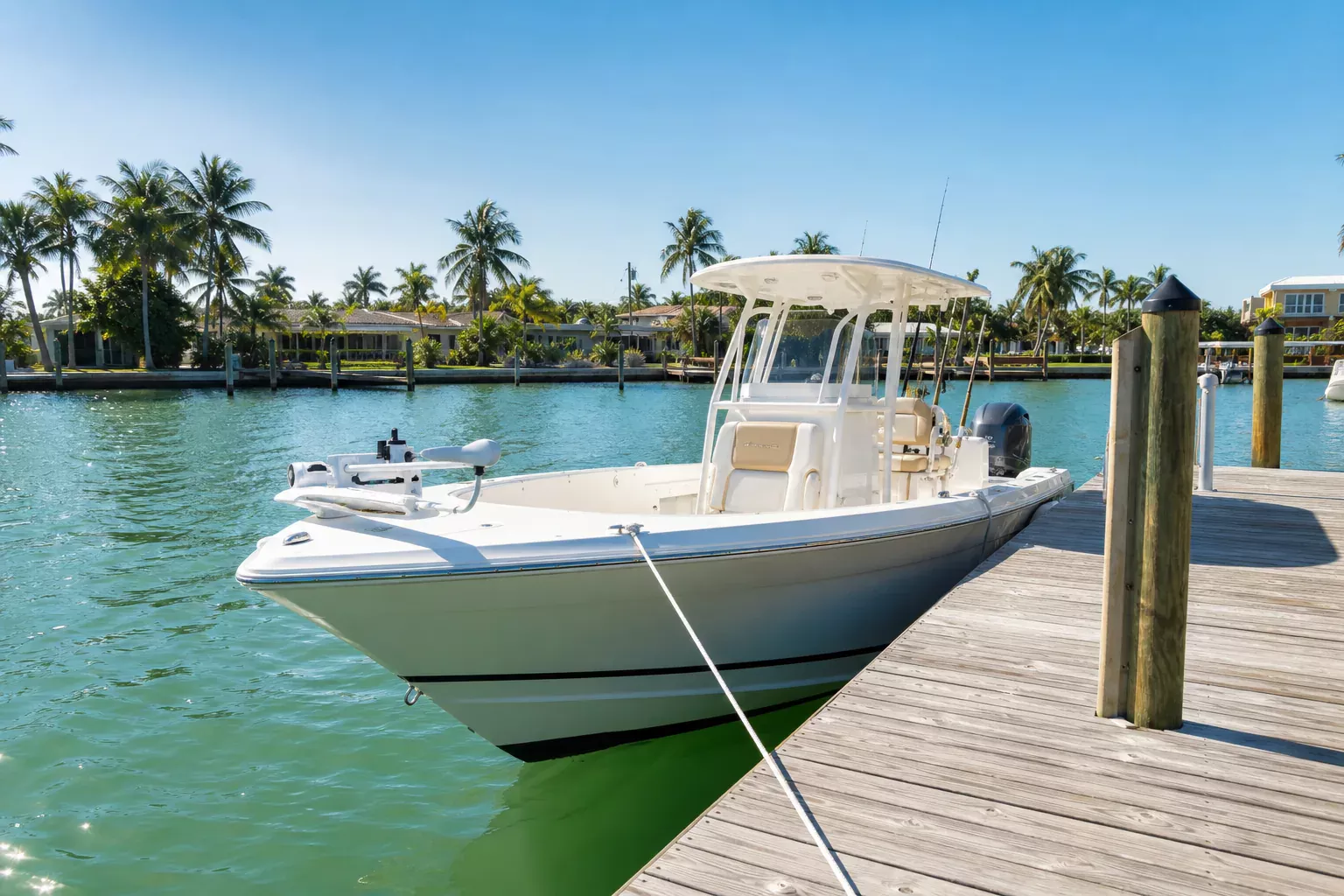
Most “boat transport near me” searches mix sailboats, express cruisers, and skiffs into one picture. A center console fights different variables: usually no mast, but often a T-top or hardtop, rocket launchers, antennas, and outriggers that stick past the gunwales when deployed. Livewells and bilges hold water that should not ride across state lines. Many owners already have a trailer—so the first decision is whether that trailer is safe for a commercial tow, or whether the boat needs a purpose-built boat transporter.
For the broader dimensions fork (owner trailer vs specialized yacht-style equipment), see trailerable vs yacht boat transport. For wet/dry marina loading choreography, use marina-to-marina boat transport. Vessel-type context for this niche lives on powerboats and center consoles. This page stays on T-tops, outriggers, beam checks, powerboat-specific prep, and the owner-trailer vs commercial-trailer call.
T-tops, hardtops, and loaded height
Highway height is measured from pavement to the highest fixed point on the loaded combination—not from the waterline on a brochure drawing. On a center console that usually means the top of the T-top frame, hardtop, antenna bases left standing, or rod holders that stick above the roof. Soft tops and canvas that can be dropped help; welded aluminum frames and molded hardtops do not.
There is no single federal maximum height for recreational boat loads. States set vertical clearance and oversize rules. In practice, many jurisdictions treat roughly 13 feet 6 inches of total loaded height as the line where permits, restricted routes, and sometimes height poles enter the conversation. Measure after the boat is on the trailer you will actually use, with bunks or pads under the hull the way they will ride. Include:
- T-top or hardtop crown
- Antennas you will leave up (most should come down)
- Any radar, spotlight, or camera mount that stays mounted
- Trailer frame rise, bunk height, and tongue geometry
If your measured height is close to a state’s limit, do not “guess it will be fine.” Share photos of the boat on the trailer with a tape in frame. Carriers would rather plan a lower bunk setup, fold hardware, or select a different trailer than discover a bridge clearance issue halfway through the lane.
Outriggers, antennas, and what must come down
Outriggers are the classic center console gotcha. Deployed, they can push width far past legal lane limits and snag trees, signs, or other traffic. Even folded along the gunwale, long poles can still add inches you did not budget. Antennas, VHF whips, and GPS mushrooms are smaller but still matter for height and for chafe against straps and tarps.
Owner actions that prevent day-of delays:
- Fold or remove outriggers before the driver arrives, and store poles where they cannot roll free in the cockpit.
- Lower or remove antennas unless the carrier specifically asks you to leave a short stub for identification—most prefer them down.
- Clear rocket launchers and rod holders of rods, gaffs, and loose gear. Highway vibration turns forgotten tackle into projectiles.
- Photograph the “road ready” configuration so the quote matches what shows up at pickup.
Federal size policy for commercial boat transporters focuses more on length than on your T-top, but it explains why professional carriers use specialized combinations. Under 23 CFR § 658.13, boat transporters are specialized equipment: states may not impose overall length limits below 65 feet for traditional boat transporters (or truck-trailer boat transporters) or 75 feet for stinger-steered combinations, exclusive of overhang, with minimum overhang allowances of 3 feet front and 4 feet rear. FHWA’s boat-transporter Q&A restates those National Network minimums for owners who want the policy source in plain language (FHWA size and weight FAQs — boat transporters). Florida’s highway statutes echo specialized boat-transporter length concepts for in-state operation (Florida Statutes § 316.515).
Beam on trailer vs brochure beam
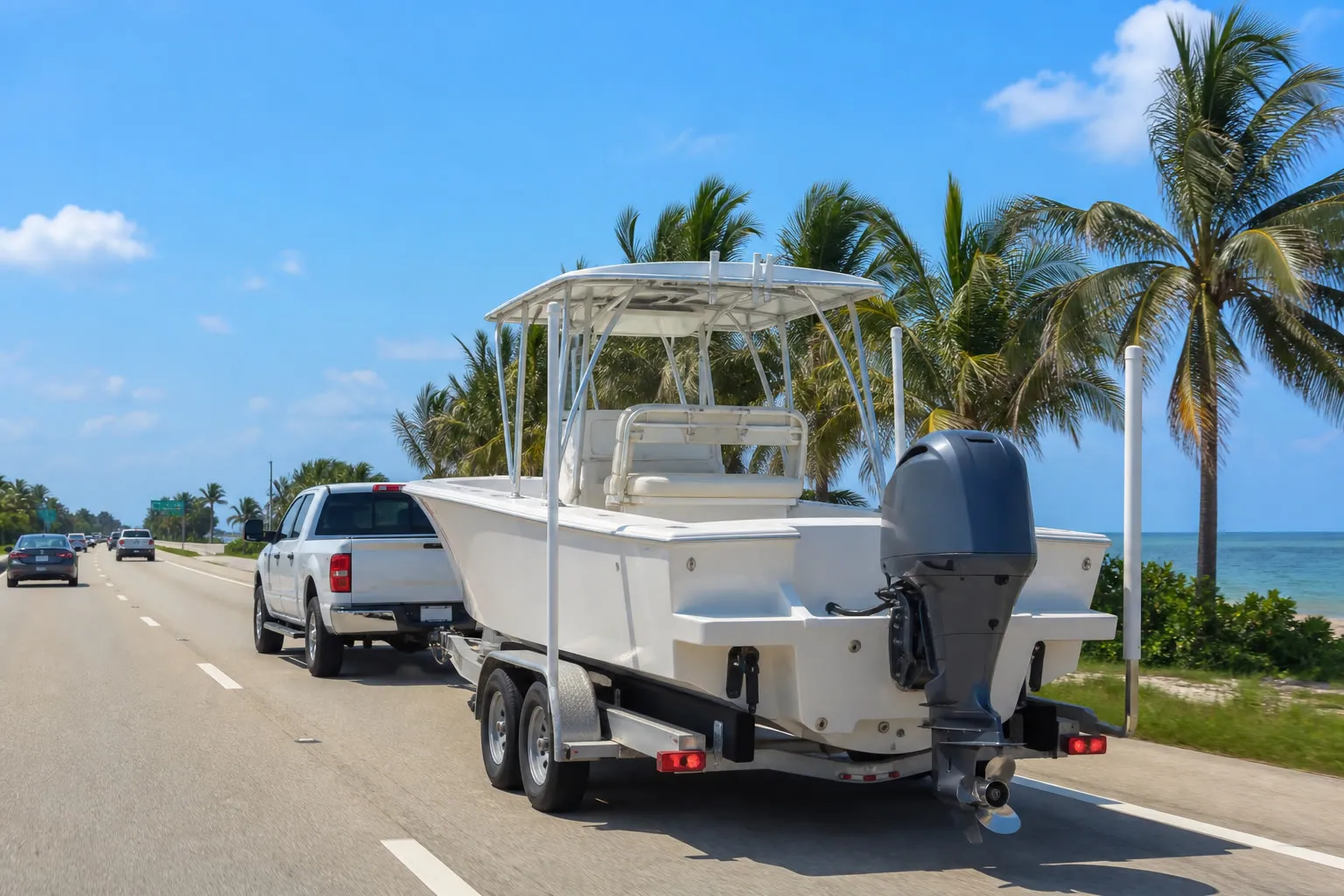
Brochure beam is the hull width the builder advertises. Loaded transport beam is what sticks out once the boat sits on bunks or rollers, with rub rails, aftermarket rod holders, trolling-motor brackets, jack plates, and trailer guide-ons in play. A boat listed at 8’6" can measure wider on a trailer with tall guide poles or with outriggers incompletely folded.
Measure beam at the widest point of the loaded package—hull, hardware, and trailer components that extend past the hull. Why it matters:
- Many states treat roughly 8 feet 6 inches of width as the legal maximum without an oversize permit on standard highways (confirm each state on your route).
- Overwidth triggers permits, restricted travel hours, and sometimes escorts—cost and schedule items you want priced before you book a closing or tournament.
- Carriers match equipment to true width. An 8’4" bay boat on a tidy trailer is a different job than a 9’2" offshore console with fixed outrigger bases.
If you are unsure whether your boat stays in the “owner trailer” lane or needs a commercial boat trailer, send both numbers: brochure beam and measured loaded width. That single clarification prevents most quote churn on center console boat transport near me requests.
Owner trailer vs commercial boat trailer
Plenty of center consoles live on a dual-axle bunk trailer and tow fine behind a family truck. Commercial transport is different: the combination may move farther, faster, and under carrier insurance and hours-of-service rules. The question is not pride of ownership—it is whether your trailer is roadworthy and correctly matched for a professional tow.
| Scenario | Usually works | Watch-outs |
|---|---|---|
| Boat stays on owner trailer | Trailer matches hull (bunks/rollers fit), tires and bearings are sound, lights and brakes work, VIN/title paperwork is clear, and loaded height/width are legal or permit-ready. | Under-rated axles, dry-rotted tires, seized brakes, missing spare, unknown bearing history, or a trailer never used for interstate miles. Carriers may reject the trailer and require a boat-only move. |
| Boat moves to commercial boat trailer | Owner trailer is unsafe, wrong bunk geometry, or you need specialized low-profile equipment for height. Also common when the boat is stored on stands or in a wet slip with no trailer at all. | You still need accurate LOA, beam, and height. Loading may require a ramp, forklift, or travelift—coordinate access early. |
Be honest about trailer condition—a rejected trailer on pickup day costs more than a pre-trip tire and bearing service. Lanes and equipment overview: boat transport.
Livewell, bilge, and powerboat-specific prep
Center consoles and bay boats carry water systems that sailboats and dry-stored yachts do not emphasize the same way. Stagnant water adds weight, can freeze in shoulder seasons, and creates odor and corrosion complaints at delivery. Before haul day:
- Drain livewells and baitwells; leave lids ajar if the carrier agrees so they can air.
- Pump the bilge dry and confirm auto-float switches are not cycling against a weak battery.
- Disconnect or secure batteries per carrier preference; label the house vs start bank if you have both.
- Remove or lash coolers, tackle bags, and loose electronics—highway vibration opens latches.
- Secure console doors and hatch lids; tape is not a substitute for working latches, but soft foam at chafe points helps.
- Set jack plate and trim for travel clearance, not fishing trim.
Layer these items on the master checklist at prep for haul. Keep required safety gear serviceable under the Coast Guard recreational framework (U.S. Coast Guard Boating Safety — federal regulations). Builder and capacity-plate context from the National Marine Manufacturers Association (NMMA) helps when a yard cites lift points. Florida owners can skim FWC Boating for registration and safety expectations alongside the highway move.
What to send for an accurate center console quote
When you request center console boat transport near me pricing, one clean packet beats three rounds of follow-up photos:
- Make, model, year, LOA, brochure beam, and approximate weight
- T-top, hardtop, or open bow—plus measured loaded height if you already have the boat on a trailer
- Outrigger type (none, fold-down, fixed) and whether they will be removed
- Engine count and horsepower (single/twin/triple), jack plate, and trolling motor
- Current setup: on owner trailer, on stands, or in a slip
- Trailer details if it must roll with the boat: axle count, tire age if known, brake type
- Pickup and delivery addresses, gate codes, and any low trees or tight turns
- Hard dates (closing, tournament, storage start)
Walk the full pricing workflow on how to get a boat quote, skim coverage for cargo insurance questions, and check FAQ before you call. If your boat is actually a sail program with mast work, switch to the sailboat transport near me Guide instead—different spar and keel rules apply.
Day-of notes for center console owners
- Have the boat road-ready: wells drained, antennas down, outriggers folded or removed, cockpit clear.
- Be reachable—or appoint someone with keys and authority—while the driver checks strap points and lights.
- Stay clear of winch lines and strap paths; the driver owns highway securement.
- Photograph port, starboard, bow, stern, and T-top before departure; keep a copy of the condition notes.
- Expect light gelcoat rub at bunk and strap contact points on long hauls; escalate for structural or unexplained impact damage.
Request center console haul pricing
Have LOA, beam, loaded height, T-top/outrigger status, engines, and trailer condition ready. Logi Transports LLC matches equipment to your powerboat—not a sail or yacht template.
Call (864) 791-5644 · quotes@logitransports.com · Contact
Logi Transports LLC · Sebastian, FL · MC-1636889 · USDOT 4230991 · Boat Transport Near Me — boattransportnearme.com