
Searching yacht transport near me usually means an express cruiser, cabin yacht, or flybridge boat that will not fit a family trailer—and whose height story starts at the command bridge, not a T-top. Radar arches, canvas enclosures, and soft goods decide whether the load clears typical state height thresholds or needs a reduced-height plan. This owner-facing Guide is for cabin and flybridge yacht shippers who need a practical haul brief—not a center-console outrigger checklist and not a sailboat mast-and-keel schedule.
Boat Transport Near Me is operated by Logi Transports LLC (Sebastian, FL · MC-1636889 · USDOT 4230991). Call (864) 791-5644 or email quotes@logitransports.com when you are ready to price a yacht or express-cruiser haul.
Why yacht and express-cruiser hauls differ
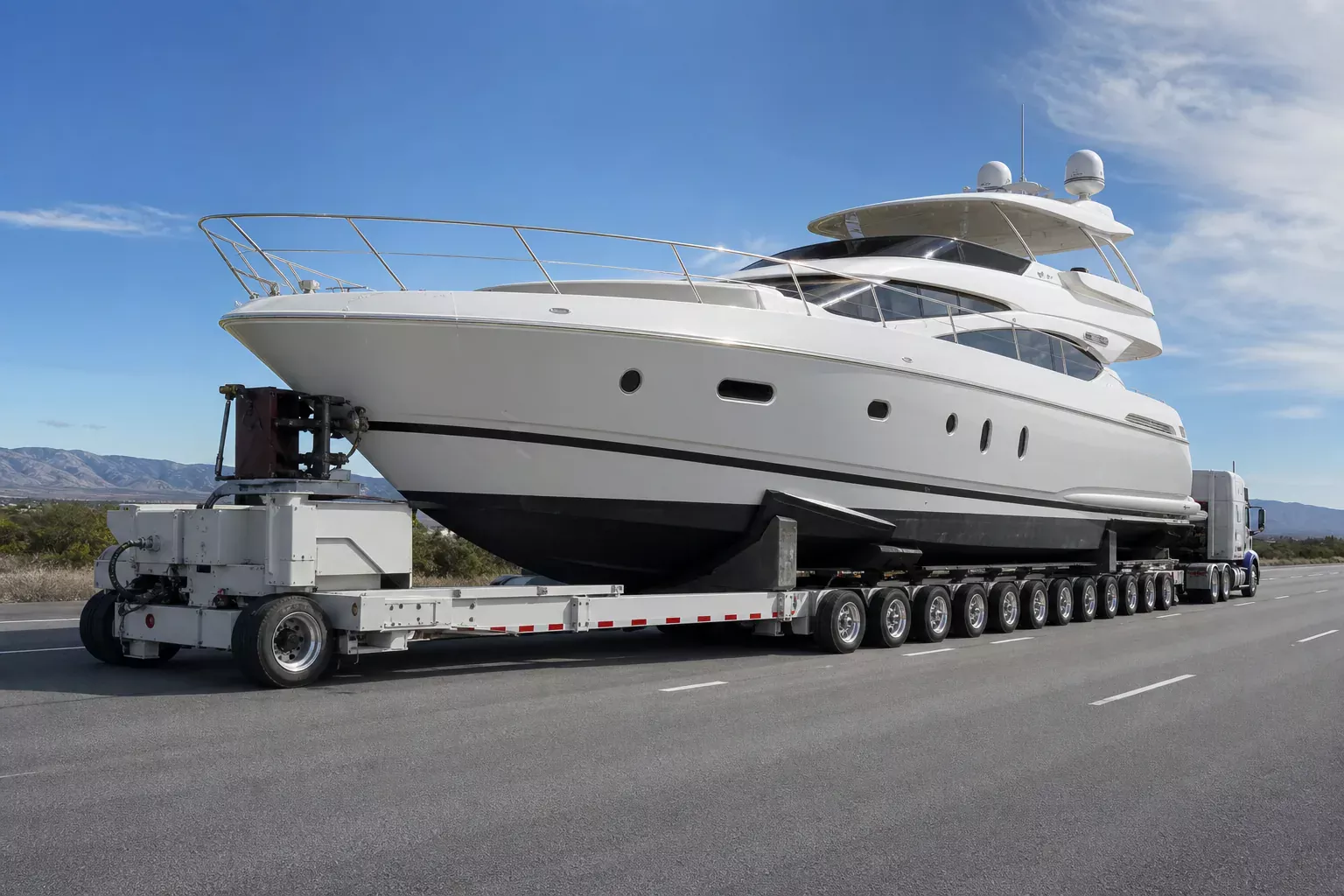
Center consoles fight T-tops and outriggers. Sailboats fight spars and keels. Cabin yachts and express cruisers fight a different stack: a flybridge or raised helm, fixed or removable radar arches, bimini and camper canvas, and an interior full of cabinetry, electronics, and soft goods that will shift under highway vibration. Brochure air draft is almost never the number that matters on the road; loaded height from pavement to the highest fixed point on the combination is.
If your boat is still in the “maybe my trailer works” zone, start with trailerable vs yacht boat transport. Vessel-type context for this niche lives on yachts. For fishing powerboats with T-tops, use the center console boat transport near me Guide instead. For mast step/unstep and keel pads, switch to sailboat transport near me. This page stays on flybridges, radar arches, soft goods, and cabin prep.
Flybridges, command bridges, and loaded height
A flybridge or command bridge is often the tallest fixed structure on a cabin yacht. Soft tops can sometimes be collapsed; molded hardtops, radar masts bolted through the bridge, and windshield frames usually cannot. Highway height is measured after the boat is on the trailer or cradle you will actually use—including bunk or pad rise—not from a waterline drawing in the owner’s manual.
There is no single federal maximum height for commercial vehicles. FHWA’s size-and-weight overview states that vehicle height is left to the states, which commonly range from about 13.6 feet to 14.6 feet (FHWA Commercial Vehicle Size and Weight Program overview). In practice, many states treat roughly 13 feet 6 inches of total loaded height as the line where oversize permits, restricted routes, and sometimes escorts enter the conversation. Florida’s statute is explicit for in-state operation: no vehicle may exceed 13 feet 6 inches inclusive of load, with a limited automobile-transporter exception that does not rewrite yacht-haul planning (Florida Statutes § 316.515).
When you measure for a yacht transport near me quote, include:
- Flybridge or hardtop crown as it will ride (canvas up or down as planned)
- Radar, spotlight, and camera mounts you will leave installed
- Any arch, antenna base, or searchlight that stays bolted
- Trailer or cradle rise under the keel and pads
If measured height sits within a few inches of a state’s threshold, do not assume “it will clear.” Share side-profile photos with a tape in frame so the carrier can choose a lower deck, plan arch removal, or price permits honestly.
Width still matters on cabin beams
On the National Network, federal commercial width is fixed at 102 inches (8 feet 6 inches), exclusive of certain safety devices, as summarized in the same FHWA size-and-weight overview linked above. Many cabin yachts sit at or beyond that beam once rub rails, swim platforms, and trailer guides are in play. Overwidth is a permit and routing issue separate from flybridge height—report both numbers.
Radar arches, antennas, and what comes off
Radar arches and multi-function electronics masts are the classic express-cruiser height problem. A dome bolted to a stainless or aluminum arch can add the inches that push a load from legal-height into permit territory—or from an easy corridor into a detour-heavy route. Antennas, GPS mushrooms, and VHF whips are smaller but still count when they sit above the arch.
Owner actions that prevent day-of delays:
- Decide early whether the arch stays up, comes off at the yard, or rides deck-strapped. Label connectors before unbolting.
- Lower or remove antennas unless the carrier asks for a short stub left for identification.
- Photograph the “road configuration” so the quote matches what the driver sees at pickup.
- Bag fragile light bars and open-array radars according to yard or installer guidance—highway vibration is not marina dock motion.
Federal policy treats boat transporters as specialized equipment. Under 23 CFR § 658.13, states may not impose overall length limits below 65 feet for traditional boat transporters (or truck-trailer boat transporters) or 75 feet for stinger-steered combinations, exclusive of overhang, with minimum overhang allowances of 3 feet front and 4 feet rear. Length rules do not remove your flybridge—but they explain why professional yacht haulers use purpose-built combinations instead of a generic flatbed.
Soft goods and interior prep for cabin yachts
Canvas and soft goods are where express-cruiser hauls look “clean” at the dock and then shred on the interstate. Biminis, camper backs, bridge enclosures, and cockpit covers catch wind like sails. Interior drawers, hanging lockers, and salon cushions shift when latches are weak. Treat soft goods as part of the height-and-damage plan, not as an afterthought.
- Collapse or remove canvas the carrier will not protect in the wind stream; store enclosures dry in labeled bags below or in a cabin locker that latches.
- Secure bridge and cockpit cushions; loose foam becomes airborne chafe pads against gelcoat and acrylic.
- Latch every drawer, hatch, and companionway; use soft foam at known chafe points on rails and corners.
- Remove or crate loose electronics, TVs, and artwork that sit on brackets not rated for highway vibration.
- Drain freshwater and holding tanks as the yard or carrier requests; stagnant water adds weight and odor.
- Disconnect or secure batteries per carrier preference; label house vs start banks.
Layer these steps on the master checklist at prep for haul. Keep required recreational safety gear serviceable under the Coast Guard framework (U.S. Coast Guard Boating Safety — federal regulations). When a yard cites lift points or capacity plates, follow the builder’s documentation for that hull.
Flybridge-up vs reduced-height: quick comparison
| Approach | When it fits | Owner watch-outs |
|---|---|---|
| Flybridge / arch up | Measured loaded height stays under corridor limits (often near 13’6" in many states) or permits/escorts are already priced into the schedule. | Canvas left standing can tear; antennas left up add unexpected inches; permit routes add miles and time. |
| Reduced-height plan | Arch removal, canvas down, lower trailer deck, or a combination brings the load under common height thresholds and opens more routing options. | Yard time and reconnect labor at destination; label every connector; photograph before and after disassembly. |
Neither path is “always cheaper.” A few inches of height can change corridor choice more than a few feet of LOA. That is why accurate photos beat round-number estimates when you ask for yacht transport near me pricing.
Quote packet checklist for cabin and flybridge yachts
Send one clean packet so equipment and permits can be planned once:
- Make, model, year, LOA, beam, and approximate displacement
- Flybridge / sedan / express layout—and whether the bridge is soft-top or hardtop
- Radar arch status (fixed, removable, already removed) and antenna plan
- Best-known loaded height if the boat is already on a trailer or cradle; otherwise air draft plus pad estimate
- Current location: wet slip, dry stack, stands, or owner trailer
- Pickup and delivery access notes (gate codes, travelift, low wires, tight turns)
- Hard deadlines (closing, seasonal storage, yard step-in dates)
- Side, stern, and bridge photos with canvas visible
Walk the full pricing workflow on how to get a boat quote, then reach the Sebastian, FL desk via contact when dimensions and photos are ready.
Day-of notes for yacht owners
- Have the boat in the agreed road configuration: canvas down or removed, antennas lowered, interior latched, tanks addressed.
- Be reachable—or appoint someone with keys and authority—while the driver checks strap points and lights.
- Stay clear of winch lines and strap paths; the driver owns highway securement.
- Photograph port, starboard, bow, stern, and bridge before departure; keep a copy of condition notes.
- Expect light gelcoat rub at pad and strap contact points on long hauls; escalate for structural or unexplained impact damage.
Request yacht haul pricing
Have LOA, beam, loaded height, flybridge/arch status, soft-goods plan, and pickup access ready. Logi Transports LLC matches specialized boat-transporter equipment to cabin and express yachts—not a center-console or sail template.
Call (864) 791-5644 · quotes@logitransports.com · Contact
Logi Transports LLC · Sebastian, FL · MC-1636889 · USDOT 4230991 · Boat Transport Near Me — boattransportnearme.com